

© 2026 Meanhung All Rights Reserved.
Power & UPS Planning
- Meanhung Technology Co., Ltd.
- Power & UPS Planning
Choosing a UPS System
- Choose Online, Line-Interactive or Offline:
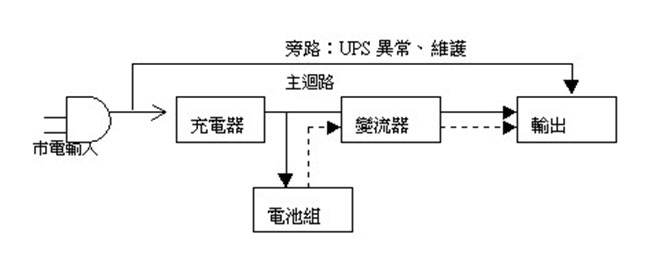
- Online UPS Suitable for power environments that require isolation. Utility power passes through a rectifier and then an inverter, ensuring highly stable power quality. With no switchover of the power source, it is the best choice for data center servers, medical equipment and high-availability devices.
- Line-interactive UPS falls between online and offline models in features and cost. Utility power likewise charges the battery through the rectifier and, when the battery is fully charged, feeds the output through a bypass. A transfer time (<20ms) is still required during an outage, which may cause a momentary power loss for sensitive loads. Suitable for environments that can tolerate brief interruptions, such as network rooms and telecom rooms.
- With an offline UPS, utility power normally passes directly to the output through a bypass, switching to the battery (converted to the output by the inverter) only when power fails. Unstable utility frequency may cause unstable output, and the very short transfer time (<20ms) may cause a momentary power loss for sensitive loads. Offline UPS units cost less and suit personal computers and general-purpose environments that do not require high stability.
- Assess the appropriate IT load and future growth: based on the current power load, multiply by two to three to allow room for growth. Note any high-performance computing needs (GPUs, AI application systems, etc.); if present, calculate those loads separately.
- Battery Planning & Design:
- Where a generator is available, the typical design scenario is “10 minutes of backup at full load”, with the generator starting and picking up the load within 3 minutes. The required battery specifications and quantity are then determined from the battery sizing calculation to meet the requirement.
- Without a generator, you need to assess the time required for servers to shut down one by one, for example a 120-minute design. The required battery specifications and quantity are then determined from the battery sizing calculation to meet the requirement.
- Battery quantities vary with requirements, but avoid over-engineering: beyond the high cost, it also raises future maintenance and replacement costs, all of which should be considered.
Choosing a Redundancy Mode
- Traditional 1+1 mode: in a traditional small server room, UPS_A feeds rack circuit A (PDU_A) and UPS_B feeds rack circuit B (PDU_B), with each server's power supplies (Power Supply) connected to PDU_A and PDU_B respectively. When a UPS is shut down for maintenance, half the PDUs immediately lose power, and any equipment with a single power supply becomes a single point of failure.
- N+1: UPS units are connected in parallel through a synchronizer, combining their output current and allowing one UPS to be shut down for maintenance. For example, with two UPS units in parallel, when one is down the other must carry 100% of the load, so the normal load must stay below 50% of total capacity.
With three UPS units in parallel, for example, when one is down the other two must carry 100% of the load, so the normal load must stay below 66% of total capacity, and so on. Single points of failure are therefore unlikely in this redundancy mode. - Modular UPS: a modular UPS is a single rack frame in which each power module is a complete UPS. Installing two or more power modules meets the N+1 requirement. This approach saves data center floor space, simplifies maintenance and allows battery banks to be shared. When maintenance is needed, simply isolate the faulty power module and pull it out for repair, making it a better choice for data centers than the N+1 mode.